Acceptable radon levels by state don’t actually change: the EPA’s action level of 4 pCi/L, the point at which the agency recommends fixing your home. What actually changes from state to state is not the standard; it is the average amount of radon actually found in homes.
At Champia Real Estate Inspections, we test for radon in every home we inspect across Georgia and Michigan, two states with very different average levels. This guide breaks down what “acceptable” really means, how Georgia and Michigan compare, and what to do if your own test comes back high.
What Counts as an “Acceptable” Radon Level?
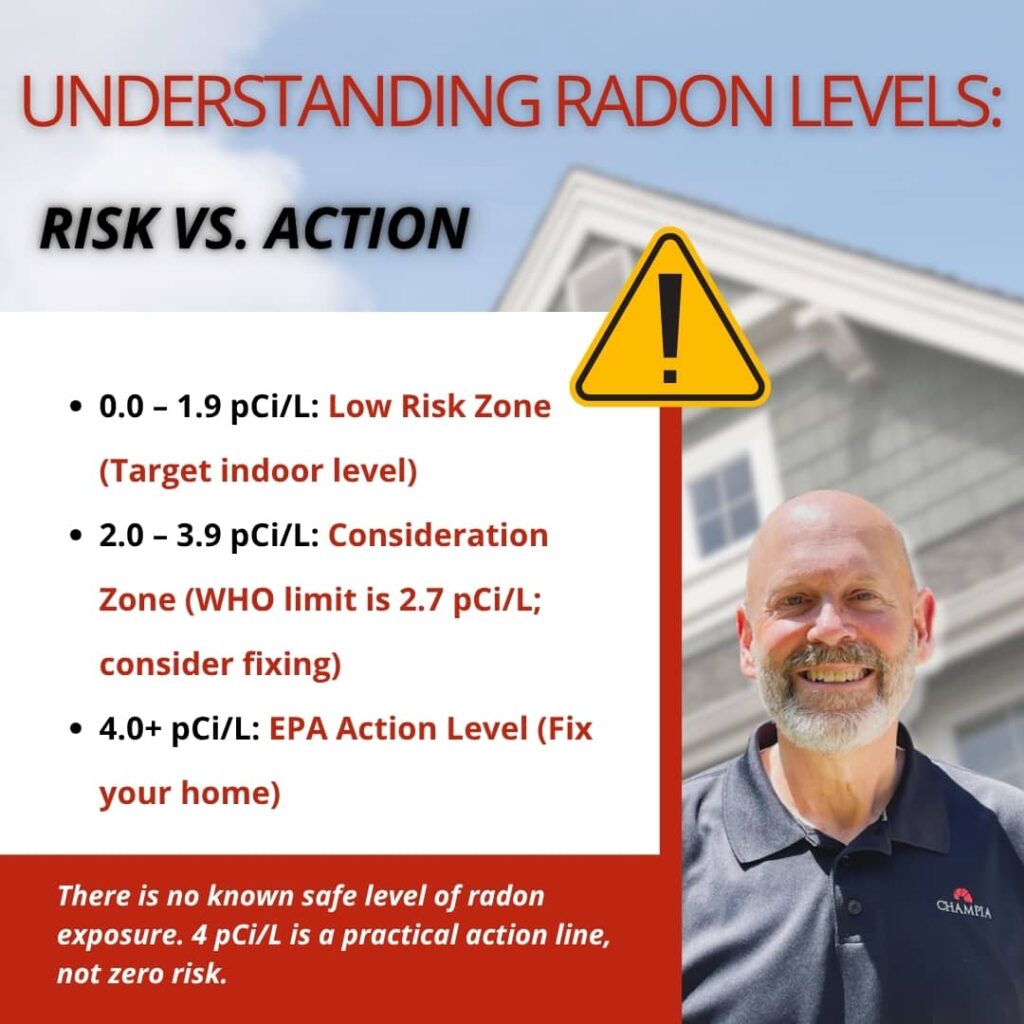
An acceptable radon level is 4 pCi/L (picocuries per liter) or below, according to the EPA’s national action level guidance. At or above that number, the EPA recommends fixing your home.
Between 2 and 4 pCi/L, the agency says fixing your home is still worth considering, even though it is not a hard requirement. There is no dose of radon considered completely safe. The 4 pCi/L line is a practical action threshold, not a claim that anything below it carries zero risk.
This standard is federal and applies the same way in Georgia, Michigan, Alaska, or anywhere else in the country. States do not set their own separate “acceptable” indoor-air number.
A handful of states do set their own limits for radon dissolved in drinking water, which is a different measurement entirely and easy to confuse with the indoor-air standard covered here.
Connecticut, Maine, and several other states publish water-radon guidance measured in the thousands of pCi/L, a completely different scale from the indoor-air number this post focuses on.
It is also worth knowing that the World Health Organization recommends a stricter benchmark, closer to 2.7 pCi/L, than the EPA’s 4 pCi/L action level. The EPA’s number is not a claim that WHO is wrong.
It reflects a practical balance between health risk and the cost of mitigation across a huge range of housing stock. If you want to be conservative, treating 2 pCi/L as your personal action point, rather than waiting for 4, is a reasonable choice, especially for a home where someone smokes, since radon and smoking have a compounding effect on lung cancer risk.
Why Radon Levels Vary by State (Even Though the Standard Doesn’t)
Radon comes from the natural breakdown of uranium in soil and rock, and it seeps into homes through foundation cracks, sump pits, and gaps around pipes.
Because radon enters homes through the ground rather than the air outside, the amount you are exposed to depends heavily on the geology under your specific property, and geology is not evenly distributed across the country.
The EPA groups counties into three radon zones based on average predicted indoor levels:
- Zone 1: average predicted level greater than 4 pCi/L (highest potential)
- Zone 2: average predicted level between 2 and 4 pCi/L (moderate potential)
- Zone 3: average predicted level less than 2 pCi/L (lowest potential)
Regions with certain granite, shale, or phosphate-rich soils, common across the Appalachian and Piedmont belt, the Upper Midwest, and parts of the Rocky Mountains, tend to sit in Zone 1 far more often than the Gulf Coast or parts of Florida and Hawaii, where soil composition and geology work in homeowners’ favor.
The EPA built its zone map using county-level indoor radon measurements combined with geology, soil permeability, and aerial radioactivity data, then classified each county by its average predicted level.
That means the map is a starting point for understanding regional risk, not a substitute for testing your specific address. Two houses on the same street can post very different results depending on foundation type, ventilation, and how the home was built.
A home with a full basement dug into bedrock behaves differently than a home on a slab or a crawl space, which is one reason foundation type shows up as a factor on every radon test report Champia’s inspectors write up.
How Georgia and Michigan Compare
Georgia and Michigan sit on very different points of that map, which is exactly why the “same standard, different averages” distinction matters for Champia’s service areas.
| EPA Action Level | Approximate State Average | EPA Radon Zone Mix | |
|---|---|---|---|
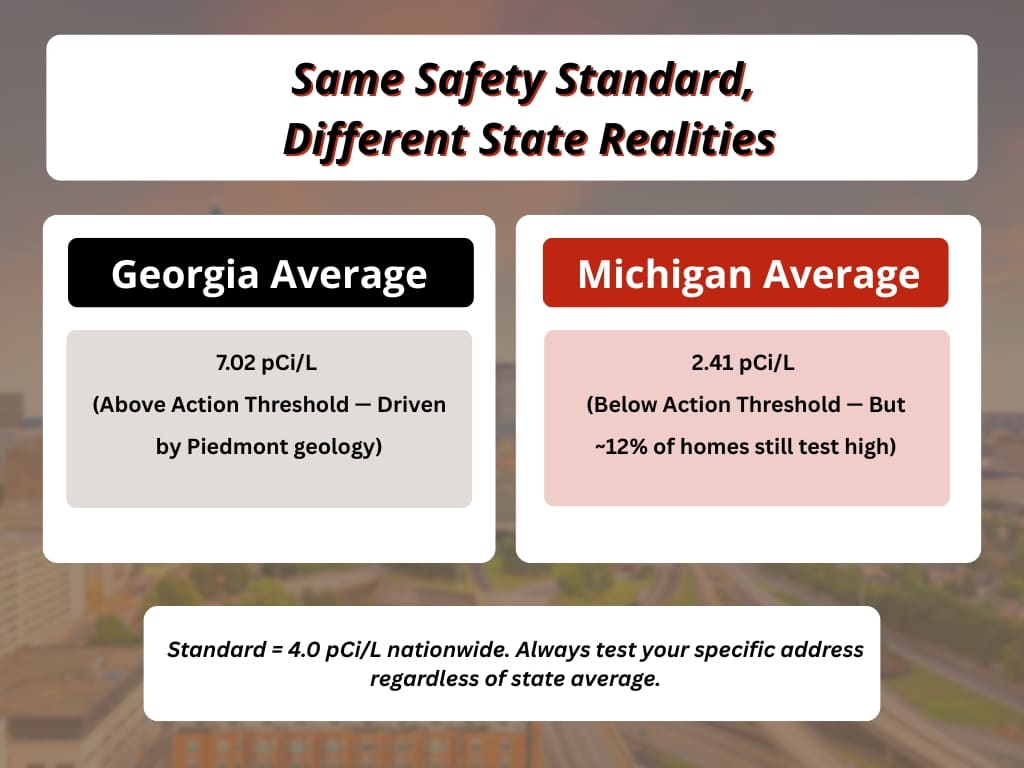
| Georgia | 4.0 pCi/L (national standard) | ~7.02 pCi/L | 4 Zone 1 counties, 55 Zone 2, 100 Zone 3 (159 total) |
| Michigan | 4.0 pCi/L (national standard) | ~2.41 pCi/L | Mixed Zone 1, 2, and 3 by county |
| Alaska (highest in the US) | 4.0 pCi/L (national standard) | ~10.7 pCi/L | Predominantly Zone 1 |
| Hawaii (lowest in the US) | 4.0 pCi/L (national standard) | Near 0 pCi/L | Predominantly Zone 3 |
Georgia’s statewide average sits well above the national action level, driven largely by the Piedmont region between the Fall Line and the Blue Ridge foothills, while South Georgia’s coastal plain runs closer to Zone 3.
Michigan’s average is lower, but roughly 12% of Michigan homes still test above the 4 pCi/L action level, which means a below-average statewide number does not guarantee any individual home is in the clear.
What Your Radon Test Result Actually Means
Radon test results come back in pCi/L, and there are two main testing formats:
- Short-term tests run for 2 to 90 days and are common during a real estate transaction, since they give a quick read before closing.
- Long-term tests run for more than 90 days and give a more accurate picture of your home’s year-round average, since radon levels can shift with the seasons, ventilation habits, and even the weather.
A single short-term test above 4 pCi/L is generally enough to warrant a second test or a mitigation conversation. If your result is borderline, in the 2 to 4 pCi/L range, a longer test gives you a clearer answer before you decide whether to act.
Long-term radon exposure carries real health consequences, which is part of why the EPA and CDC both frame this as a “test regardless of your state’s average” issue rather than a “only worry if you live somewhere risky” one.
You can buy a DIY charcoal or alpha-track test kit for a home test, and these are a reasonably low-cost first check.
For a real estate transaction, though, most lenders and buyers expect a test performed by a certified professional using a continuous radon monitor, since the device logs data throughout the testing period and is harder to tamper with than a mail-in kit left sitting on a counter.
This is also why radon testing is usually bundled with a full home inspection rather than done as a standalone service.
What to Do If Your Radon Level Is Above 4 pCi/L
A radon mitigation system, typically a vent pipe and fan system that pulls radon from beneath the foundation and releases it safely outside, is the standard fix.
According to the CDC’s overview of radon and health, a properly installed system can reduce indoor radon levels by up to 99%. Costs commonly range from $700 to $4,000 depending on your home’s foundation type and size, though your actual quote will vary by contractor and region.
Most residential systems use sub-slab depressurization: a pipe run from beneath the foundation up through the house and out above the roofline, paired with a continuously running fan that creates negative pressure under the slab.
That negative pressure pulls soil gas into the pipe and vents it outside before it can seep indoors, rather than trying to filter radon out of the air after the fact. Sealing foundation cracks and improving crawl space or basement ventilation can help at the margins, but they rarely bring a genuinely high reading down to an acceptable level on their own.
A full mitigation system is the reliable fix once you are consistently testing above 4 pCi/L.
After a mitigation system is installed, retest within 30 days to confirm the level has dropped, and then periodically after that, since levels can shift over time even with a system in place.
Seasonal changes, home renovations, and even a new HVAC system can all change how your home draws air, which is why a one-time test years ago is not a substitute for a current reading.
Related Questions to Explore
Is 4 pCi/L radon considered high?
It is the point at which the EPA recommends action. Levels between 2 and 4 pCi/L are considered a gray zone worth monitoring, and there is no level of radon exposure considered entirely risk-free.
Does every state have its own radon action level?
No. The 4 pCi/L action level is federal and applies uniformly across the country. What differs by state is the average amount of radon actually measured in homes, driven by local soil and geology.
What is Georgia’s average radon level?
Georgia’s statewide average is approximately 7.02 pCi/L, well above the national action level, largely due to granite and soil composition in the Piedmont region.
What is Michigan’s average radon level?
Michigan’s statewide average is approximately 2.41 pCi/L, though about 12% of homes in the state still test above the 4 pCi/L action level.
How much does radon mitigation cost?
Most systems cost between $700 and $4,000, depending on foundation type, home size, and local contractor rates.
Can you sell a house with high radon in Georgia or Michigan?
Yes, but many buyers and lenders expect either a mitigation system or a credit at closing once a high result is disclosed. Testing early gives you time to address it on your own terms rather than during a tight closing timeline.
When to Call a Professional
At-home test kits are a reasonable first step, but a professional radon test, performed as part of a full home inspection, gives you a properly placed, properly timed measurement you can rely on for a real estate transaction or your own peace of mind.
Champia’s radon testing services in Georgia and radon testing in Michigan include a 120-day warranty, so if conditions change shortly after your test, you are covered. Our ASHI-certified inspectors can also walk you through mitigation options if your result comes back above 4 pCi/L.
Conclusion
The acceptable radon level does not change from state to state, but the odds of finding a high level in your own home absolutely do.
Keep these points in mind:
- 4 pCi/L is the national action level everywhere, not a state-by-state figure.
- Georgia’s average runs well above that number; Michigan’s runs lower, but neither state is risk-free at the individual-home level.
If you have not tested your home recently, or you are buying or selling in Georgia or Michigan, contact our team to schedule a radon test.