
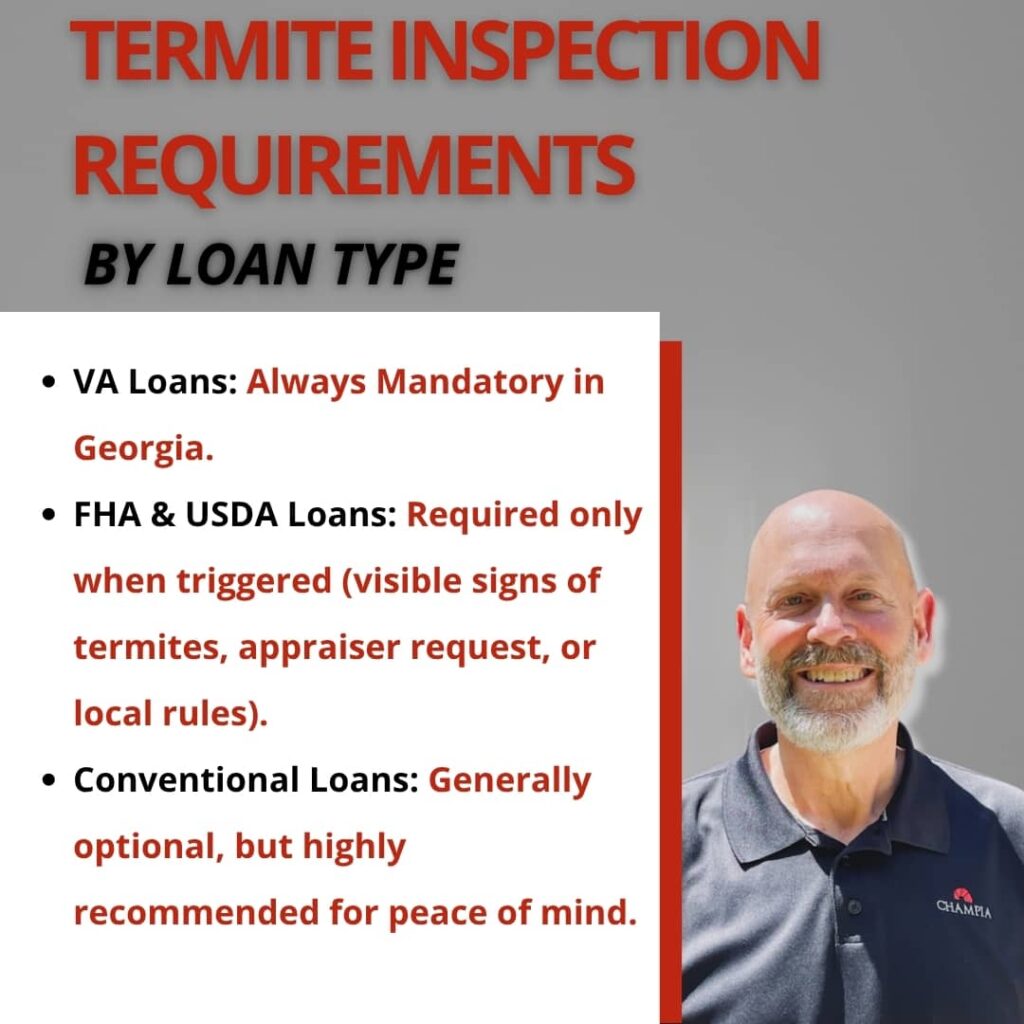
Whether you need a termite inspection for a home loan depends on the loan type and the property’s location, and in Georgia, it is required for every VA loan.
Lenders order these inspections to confirm the home has no active wood-destroying insects before they finance it, because termite damage can quietly threaten the structure they are lending against.
If you are buying in the Atlanta area, the odds are high that a termite, or WDI, inspection will come up before closing. Champia Real Estate Inspections has performed wood-destroying organism inspections across Georgia since 1987.
This guide explains which loans require one, what it covers, who pays, and what the report means.
Do You Need a Termite Inspection to Get a Home Loan?
Whether you need a termite inspection comes down to your loan type, the lender, and state and local rules. Here is how the common loan programs treat it.
VA Loans
VA loans require a termite inspection for a home loan in Georgia. The U.S. Department of Veterans Affairs sets termite-inspection requirements by region, and Georgia is a state where a WDI report is required for the whole state. You can confirm the current rules on the VA’s page of appraiser and WDI local requirements.
FHA and USDA Loans
FHA and USDA loans require a termite inspection only when it is triggered, not automatically. Common triggers include visible evidence of infestation, a property in an area where inspections are customary or state-mandated, or the appraiser or lender requesting one.
In termite-heavy Georgia, that condition is met often, so buyers using these loans should expect the possibility.
Conventional Loans
Conventional loans generally do not require a termite inspection unless the lender or appraiser asks for one. Even when it is not required, many buyers choose to get one anyway, because the cost is small compared to the price of undiscovered termite damage.
In a region with as much termite pressure as Georgia, that peace of mind is usually worth the modest fee, and it can give you leverage to negotiate repairs if the report finds a problem.
WDI, WDO, and “Termite Inspection”: What’s the Difference?
These terms overlap, which causes a lot of confusion. Here is what each one means:
- WDI (wood-destroying insect) covers termites, carpenter ants, carpenter bees, and reinfesting wood-boring beetles.
- WDO (wood-destroying organism) is broader and adds non-insect organisms like wood-decay fungi.
- “Termite inspection” is the everyday name people use for the WDI or WDO report.
In Georgia, the results are recorded on the Official Georgia Wood Infestation Inspection Report, the state’s required form for real estate transfers.
For the full breakdown of what a WDO inspection involves, see our explainer on what a WDO inspection is and when you need one. One important point: an inspection identifies and reports evidence; it is not treatment.
Champia performs the inspection and report, not extermination.
What the Inspection Covers and the Report You Get
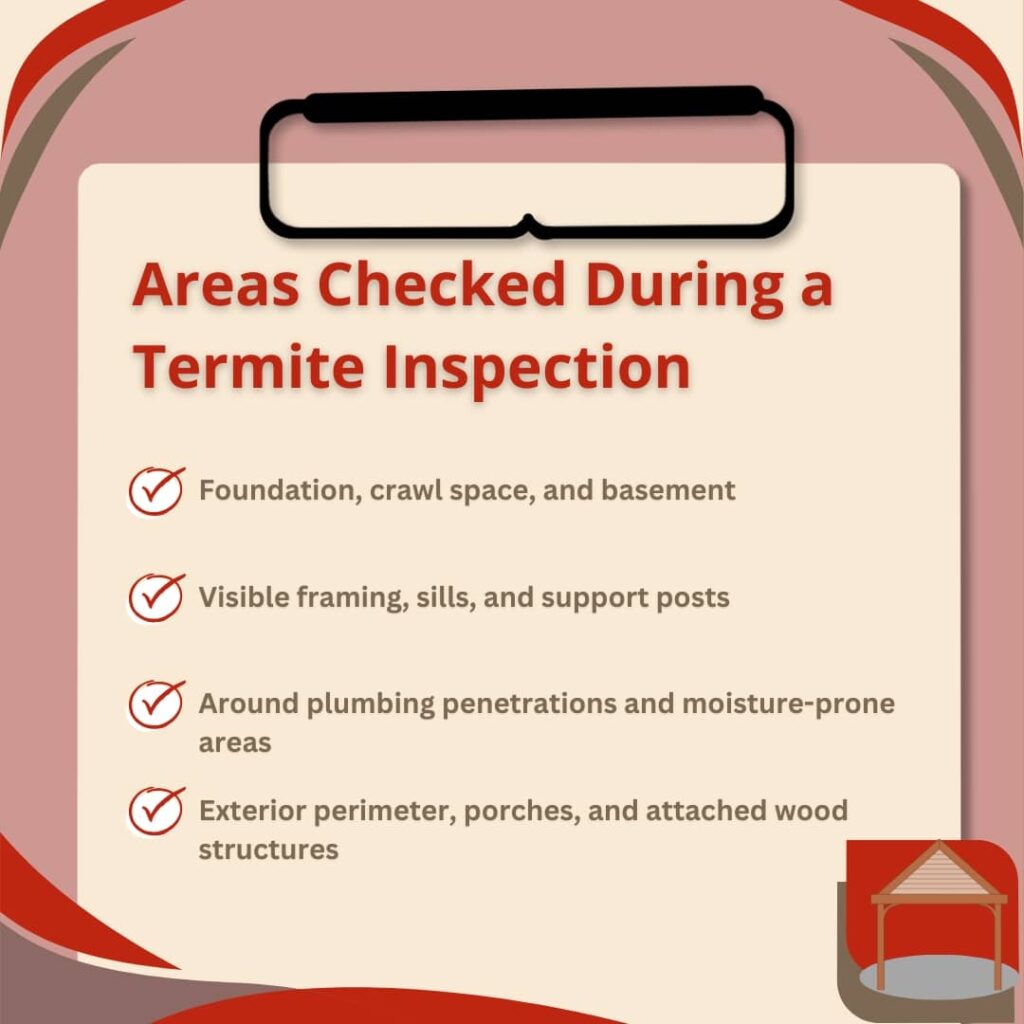
A termite inspection for a home loan is a visual examination of accessible areas of the home for evidence of wood-destroying insects, documented on a standardized report. The inspector checks the areas where activity shows up first, including:
- The foundation, crawl space, and basement.
- Visible framing, sills, and support posts.
- Around plumbing penetrations and moisture-prone areas.
- The exterior perimeter, porches, and any attached wood structures.
The inspector looks for live insects, mud tubes, damaged or hollow-sounding wood, frass, and conditions conducive to infestation. Our team has detailed how this works in how professionals inspect for wood-eating bugs.
The findings go on the report your lender needs, nationally, the NPMA-33 form, or Georgia’s state WDO form. The National Pest Management Association maintains the NPMA-33 form information, which is the standard wood-destroying-insect report used in real estate closings.
If the report finds active infestation or past damage, the deal does not automatically fall apart. The findings are documented, and the lender typically requires the issue to be treated and, in some cases, repaired before closing.
Treatment is handled by a licensed pest-control company, since the inspection and the treatment are separate services. A clear report, on the other hand, simply satisfies the lender’s condition, so the closing can move forward.
Who Pays for the Termite Inspection?
Who pays depends on the loan type and what the buyer and seller negotiate. For most purchases, the cost of a termite inspection for a home loan is small and is settled in the contract. The one program with a special history is the VA loan: for years, VA buyers were not allowed to pay the WDI inspection fee, so sellers covered it.
That changed in 2022, and Veterans are now permitted to pay the fee. It remains negotiable, and in many Georgia deals, the seller still pays, but the buyer can now cover it if needed to keep a deal moving. For conventional and FHA loans, payment is simply whatever the parties agree to.
What It Costs and How Long the Report Is Valid
A termite inspection for a home loan typically costs around $100 to $200, and in Georgia, the report is valid for 30 days. Because the report has a short shelf life, timing matters: schedule the inspection close enough to closing that the report is still valid when the lender needs it.
If a closing gets delayed past the validity window, the lender may ask for an updated report, so it is worth coordinating the inspection date with your lender and closing attorney rather than booking it the moment you go under contract. A few details to keep in mind:
| Item | Typical detail |
|---|---|
| Cost | About $100–$200 (varies by company and home size) |
| Georgia report validity | 30 days from the inspection date |
| Who can perform it | A company licensed in wood-destroying organisms, signed by the certified operator |
| Form used | NPMA-33 nationally, or Georgia’s Official WDO/WIIR form |
Buying a home involves several inspections working together, and a termite report is one piece of broader due diligence. Buyers researching the full process often start with a pre-purchase home inspection, which covers the home’s overall condition alongside the specialized WDI report.
Related Questions to Explore
Does a VA loan require a termite inspection in Georgia?
Yes. The VA requires a Termite Inspection for a Home Loan if it’s VA-financed in Georgia because the state is in a region where termite pressure makes the report mandatory. The inspection must be documented on the proper form before closing.
Does FHA require a termite inspection?
FHA requires a termite inspection only when it is triggered, such as visible evidence of infestation, a state or local mandate, or a request from the appraiser or lender. In termite-heavy areas like Georgia, that requirement comes up frequently.
Who pays for the termite inspection on a VA loan?
Since 2022, VA buyers have been allowed to pay the WDI inspection fee, which they previously could not. It is negotiable, so the seller often still covers it in Georgia, but either party can pay depending on the contract.
What is the NPMA-33 form?
The NPMA-33 is the standardized national wood-destroying-insect inspection report created by the National Pest Management Association. Lenders use it to document the results of a termite inspection at closing, though Georgia also has its own state WDO form.
Is a termite inspection required for a conventional loan?
Usually not. Conventional loans generally do not require a termite inspection unless the lender or appraiser specifically asks for one. Many buyers still choose to get one, since it is inexpensive insurance against costly hidden damage.
When to Call a Professional
Call a licensed inspector as soon as you are under contract, so the WDI report is ready and still valid when your lender needs it. Termite evidence is easy to miss for an untrained eye, and a lender will not accept anything but a report from a licensed wood-destroying-organism inspector.
Getting it scheduled early keeps your closing on track and gives you time to negotiate if the report turns up a problem. Termites are just one of the structural risks buyers weigh, alongside issues like buying a house with foundation problems, so pairing your WDI report with a full home inspection gives you the complete picture before you commit.
Champia Real Estate Inspections has completed more than 100,000 inspections across Georgia since 1987 and provides the wood-destroying organism reports lenders require. Our certified inspectors serve the Atlanta metro and beyond.
To get your report scheduled, learn about our termite inspection services, or schedule an inspection today.
Conclusion
A termite inspection is a small step that keeps your home loan and your investment on solid ground. Keep these takeaways in mind:
- VA loans require a WDI inspection in Georgia; FHA and USDA require one when triggered; conventional loans usually do not.
- The inspection identifies evidence on a lender-accepted report (NPMA-33 or Georgia’s WDO form); it is not treatment.
- In Georgia, the report is valid for 30 days, so it is close to closing.
If you are buying a home in the Atlanta area and need a wood-destroying organism report for your lender, reach out to Champia Real Estate Inspections, and we will get you scheduled.