

An appraisal tells your lender what a home is worth. An inspection tells you what condition the home is in. Both usually happen between your accepted offer and closing, and both can change your deal.
At Champia Real Estate Inspections, we have inspected homes in the Atlanta area since 1987, and we have seen how both reports can shape a sale. The two reports look at the same house for different reasons.
This guide covers what each one checks, who orders and pays for it, the usual timeline, typical costs, and what to do if either report brings bad news.
What Is the Difference Between an Appraisal and an Inspection?
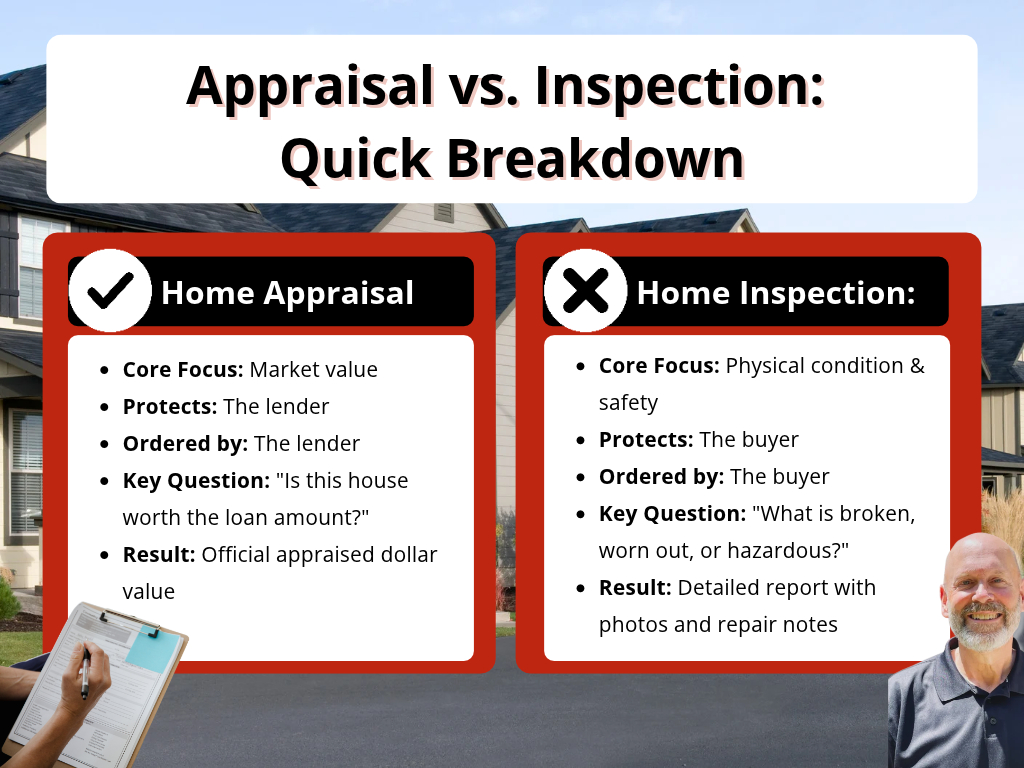
The appraisal vs. inspection question comes down to purpose. A home appraisal estimates the home’s market value for your lender. A home inspection checks the home’s condition for you, the buyer.
The appraiser answers, “Is this house worth the loan?” The home inspector answers, “What is wrong with this house, and how serious is it?”
| Home appraisal | Home inspection | |
|---|---|---|
| Main question | What is the home worth? | What shape is the home in? |
| Who it protects | The lender | The buyer |
| Who orders it | The lender | The buyer (or the seller, for a pre-listing inspection) |
| Who pays | Usually the buyer, often as a closing cost | Usually the buyer |
| Required? | Yes, for most mortgages | No, but strongly recommended |
| Who does it | A state-licensed or certified appraiser | A home inspector (Champia’s are ASHI certified) |
| Time on site | About an hour for most homes | Two to four hours for most homes |
| What you get | An appraisal report with a dollar value | A written report with photos of findings |
| Pass or fail? | It can come in at, above, or below the price | No pass or fail; it lists what was found |
Put simply, an appraisal measures value and an inspection measures condition. A home can score well on one and poorly on the other.
What Is a Home Appraisal?
A home appraisal is an independent estimate of a home’s fair market value. Your lender orders it before approving your mortgage, because the lender will not loan more than the home is worth.
The appraiser visits the home, measures it, and notes its features. Then they compare it to comparable sales (often called “comps”), which are similar homes that sold nearby in recent months.
They adjust for differences like an extra bathroom or a newer kitchen. The final number is the appraised value.
What Does an Appraiser Look At?
- Square footage and layout
- Number of bedrooms and bathrooms
- Lot size and location
- Upgrades such as a renovated kitchen or new roof
- Overall condition, at a general level
- Recent comparable sales in the area
You have a right to see the result. The Consumer Financial Protection Bureau explains that your lender must give you a free copy of the appraisal promptly, and at least three days before closing.
FHA and VA Appraisals
For FHA and VA loans, the appraiser also checks minimum property standards. These cover basic safety, soundness, and security, like a working roof and no exposed wiring.
That still is not an inspection. HUD’s own buyer notice, For Your Protection: Get a Home Inspection, states that an appraisal does not replace a home inspection.
What Is a Home Inspection?
A home inspection is a visual, non-invasive review of a home’s major systems and components, done for the buyer. The inspector looks at everything that is visible and safely accessible, then writes a report on what is working, what is worn out, and what is unsafe.
Champia inspectors follow the American Society of Home Inspectors (ASHI) Standards of Practice. Our owner, Bill Compton, is an ASHI Certified Inspector, a former Certified General Contractor, and served for years on the ASHI Board. Our team has completed more than 100,000 inspections.
What Does a Home Inspector Check?
- Roof: shingles, flashing, gutters, and signs of leaks
- Structure: foundation, framing, crawlspace, and attic
- Electrical: the panel, breakers, wiring, outlets, and GFCI protection
- Plumbing: supply and drain lines, fixtures, and the water heater
- HVAC: heating and cooling equipment and ductwork
- Exterior: siding, grading, drainage, decks, and driveways
- Interior: walls, ceilings, floors, windows, and doors
- Insulation and ventilation: in the attic and other spaces
What an Inspection Does Not Cover
A standard inspection cannot see inside walls or under floors. Some risks also need their own tests. Atlanta buyers can add radon testing, a sewer scope inspection, or a termite inspection to the visit.
Appraiser vs Home Inspector: What Each One Looks At
Both professionals walk through the same rooms, but they look at them in different ways. Here is a side-by-side view of typical scope. Exact details vary by appraiser, loan type, and inspection agreement.
| Area | Appraiser | Home inspector |
|---|---|---|
| Roof | Notes visible age and general condition | Checks shingles, flashing, and signs of leaks |
| Electrical | Confirms the home has working power | Opens the panel, tests outlets, checks GFCI |
| Plumbing | Confirms water runs | Checks supply, drains, fixtures, and water heater |
| HVAC | Notes that heating and cooling exist | Runs the system and checks its condition |
| Foundation | Notes obvious major problems | Looks for cracks, movement, and water issues |
| Attic and crawlspace | Usually not entered | Entered when safe to access |
| Market value | Compares recent nearby sales | Not part of the inspection |
Which Comes First, the Inspection or the Appraisal?
In most home purchases, the home inspection comes first. In Georgia, buyers usually schedule the inspection during the due diligence period written into the purchase contract. That window is short, so inspections often happen within the first week after an offer is accepted.
The lender orders the appraisal after you apply for the loan. It often takes place a week or two after the inspection. A typical order looks like this:
- Your offer is accepted.
- You schedule the home inspection right away.
- You review the inspection report and negotiate repairs before due diligence ends.
- Your lender orders the appraisal.
- The appraisal report comes back, and the loan moves through underwriting.
- You do a final walkthrough and close.
This order saves money. If the inspection uncovers a deal-breaker, you can walk away before paying for an appraisal on a home you will not buy. Your exact deadlines depend on your contract, so confirm them with your agent.
How Much Do an Appraisal and Inspection Cost?
An appraisal and an inspection usually cost about the same, though each fee depends on the home and the market. The price of each goes up or down with a few things:
- Home appraisal: the home’s size, location, and how complex it is to value. Large, rural, or high-end homes usually cost more to appraise. Some loan types, like FHA and VA, can also change the fee.
- Home inspection: the home’s size, age, and condition. Older or larger homes take longer to inspect, and add-on tests like radon testing or a sewer scope add to the total.
At Champia, our FlexFund option lets you inspect now and pay at closing, so the inspection fee doesn’t have to come out of pocket during due diligence. For a quote on your home, call our team or schedule online.
The buyer pays for both in most sales. The appraisal fee is often collected upfront or rolled into closing costs paid through escrow. The inspection is usually paid when the inspection is done.
If you want a number back in later, your lender’s Loan Estimate shows the appraisal fee, and Champia can supply its own inspection pricing.
What Happens if the Appraisal Is Low or the Inspection Finds Problems?
Neither report ends a deal by itself. Each one gives you options, and the right move depends on your contract and your budget.
If the Appraisal Comes in Low
Say you agreed to pay $400,000, but the home appraises at $385,000. The lender bases your loan on the lower number, which leaves a $15,000 appraisal gap. You can:
- Ask the seller to lower the purchase price
- Pay the difference in cash
- Split the gap with the seller
- Ask the lender for a reconsideration of value with better comps
- Walk away if your contract includes an appraisal contingency
If the Inspection Finds Problems
Every inspection report lists findings, even on new homes. Sort them into three groups: safety issues, major repairs, and routine maintenance. Then focus your requests on the first two. You can ask the seller to make repairs, give you a credit at closing, or renegotiate the price.
Contractor estimates make your request stronger. Our guide to common things that fail a home inspection shows the findings that come up most often.
Do You Need Both an Appraisal and an Inspection?
If you are getting a mortgage, the appraisal is required. The inspection is your choice, but skipping it means buying a home without knowing what is wrong with it. The appraiser works for the lender’s interests, not yours.
Cash buyers can usually skip the appraisal. They should still get an inspection, since no one else is checking the home’s condition.
Sellers can benefit too. A pre-listing inspection finds problems before buyers do, so you can fix them or price the home with them in mind. Our buyer and seller guide to home inspections covers both sides.
Some loans add one more report. In Georgia, many lenders, especially for VA loans, require a wood infestation report. Learn more about termite inspections for a home loan.
Related Questions to Explore
Is a home inspection and appraisal the same thing?
No. An appraisal estimates a home’s market value for the lender. A home inspection reviews the home’s condition and safety for the buyer. They are done by different professionals for different reasons.
How long after the home inspection is the appraisal?
The appraisal usually happens one to two weeks after the inspection. The inspection happens early, during due diligence. The appraisal follows once the lender has your loan application.
Can a house pass inspection but fail appraisal?
Yes. Inspections do not have a pass or fail grade, but a home in good shape can still appraise below the purchase price. That happens when recent comparable sales are lower than what you agreed to pay.
Does the home inspection affect the appraisal?
Usually not directly. The appraiser does not normally see your inspection report. However, if the appraiser notices a clear defect, they may value the home “subject to” repairs that must be finished before closing.
Does an FHA appraisal replace a home inspection?
No. An FHA appraisal checks value and minimum property standards. HUD tells buyers that an appraisal does not replace a home inspection.
Who pays for the home inspection and appraisal?
In most sales, the buyer pays for both. Sellers may pay for a pre-listing inspection before the home goes on the market.
How long is a home inspection good for?
An inspection reflects the home on the day of the visit. Our post on how long a house inspection is valid explains when a new one makes sense.
When to Call a Professional
Call a home inspector as soon as your offer is accepted. Due diligence windows are short, and a late inspection leaves little time to negotiate. Book an inspection in these situations:
- You are buying any home, new or old, with a mortgage or cash
- The home is older or shows signs of water, settling, or past repairs
- The appraiser flagged repairs on an FHA or VA loan
- The seller made repairs, and you want them checked before closing
- You are selling and want to find problems before buyers do
Champia’s ASHI-certified inspectors serve Metro Atlanta and the Ann Arbor, Michigan area. We work seven days a week and deliver home reports within 24 hours. Every inspection is backed by a money-back guarantee and a 180-day warranty. Call us or schedule your inspection online.
Conclusion
- An appraisal protects the lender by confirming value. An inspection protects you by revealing condition.
- The inspection usually comes first, during due diligence, and the appraisal follows.
- Most buyers pay for both, and each can give you room to renegotiate.
Ready to get started? Learn more about Champia’s home inspection services and book a visit before your due diligence clock runs out.